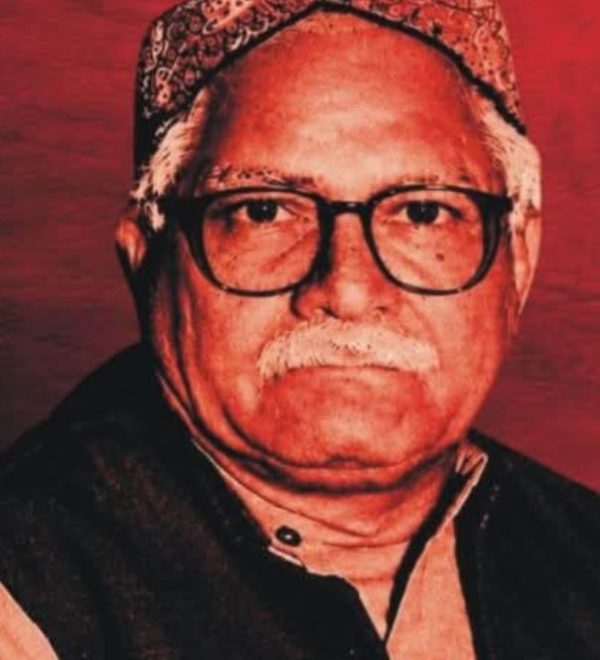
Comrade Mola Bakhsh Khaskheli was born in 1935 into a poor working-class family in the village of Kandhra, Rohri Taluka, District Sukkur, Sindh. He had little opportunity to receive formal education. However, the harsh realities of life, class exploitation and political struggle became his teachers. During his years of imprisonment, underground activities and political engagement, he taught himself to read and write. Thereafter, the pursuit of knowledge, political consciousness and revolution became the guiding purpose of his life.
Having worked as a labourer from an early age, Mola Bakhsh joined the Rohri Cement Factory in 1962, where he became actively involved in trade union activities. At the time, the workers’ union was strongly influenced by the Communist Party of Pakistan. His struggle for workers’ rights brought him closer to the communist movement, and he soon became a member of the party.
In 1966, he was elected President of the Collective Bargaining Agent (CBA) union at the Rohri Cement Factory. This was more than an organisational position; it marked the emergence of a working-class leader at the forefront of the struggle against capitalist exploitation.
During this period, the Communist Party of Pakistan established the Pakistan Workers Federation. Dr Ijaz Nazir was elected its Central President, Sham Wasti its General Secretary, and Mola Bakhsh Khaskheli its Vice-President. He subsequently also served as the Federation’s Central President.
His struggle was never confined to the trade union movement alone. He was a communist organiser who worked to unite the struggles of industrial workers, peasants and agricultural labourers. His political activities reflected his understanding that the workers’ movement, the communist party and the struggle of peasants and haris were interconnected components of the broader class struggle.
In 1975, Comrade Mola Bakhsh Khaskheli became a member of the Sindh Provincial Committee of the Communist Party of Pakistan. In 1987, he was elected General Secretary of the party’s Sindh Provincial Committee and became a member of its Central Committee. In 1988, he assumed the responsibility of Chairman of the All Pakistan Trade Union Organisation. From 1995 to 1999, he also served as Central Vice-Chairman of the Communist Mazdoor Kissan Party.
The life of Comrade Mola Bakhsh was never one of comfort, privilege or personal interests. He endured imprisonment, hardships in detention and relentless state repression. During the brutal military dictatorship of General Zia-ul-Haq, his opposition to the military establishment and his persistent struggle for workers’ rights forced him to remain underground for nearly a decade. He also spent more than five years in prison.
It was a period when the military dictatorship ruthlessly employed state power to crush political activists, silence democratic voices and dismantle the workers’ and peasants’ movements. Yet Chacha Mola Bakhsh neither surrendered nor compromised his convictions. Even during the most difficult years of underground existence, he played a significant role in keeping the Communist Party and the Sindh Hari Committee organised, active and engaged in political struggle.
Affectionately known among his comrades as “Chacha”, Mola Bakhsh Khaskheli began his journey in an ordinary working-class family in Sindh and ultimately rose to become General Secretary of the Communist Party of Pakistan.
His life reminds us that the history of the communist movement is not merely a history of congresses, resolutions and central committees. Behind it lies the experience of thousands of workers whose lives unfolded in factories, who organised themselves through trade unions, endured trials in prisons and marched at the forefront of demonstrations and protests.
The struggles of the workers at Rohri Cement Factory, arrests during martial law, resistance against privatisation, trade union organisation and the reorganisation of the Communist Party were not isolated episodes in Mola Bakhsh Khaskheli’s life. Rather, they were interconnected stages of one continuous political journey.
At approximately 11:00 pm on 30 August 2011, he passed away at the age of 76, but the question raised by his life remains relevant: Can an ordinary working-class person become an active participant in shaping the history of their times?
Following his death, the Communist Party of Pakistan received tributes and condolence messages from communist parties and revolutionary organisations in more than forty countries. This international response was a recognition that this working-class leader from Sindh was not merely a representative of Sindh or Pakistan, but also a dedicated fighter of the international working-class movement. Comrade Mola Bakhsh Khaskheli remains an enduring name in the history of workers’ struggles, peasant movements and popular resistance in Sindh.
The life of Mola Bakhsh Khaskheli provides a compelling historical answer. He did not receive his political training at prestigious educational institutions, nor did his journey begin in the corridors of power. He began as a worker, organised his fellow workers, confronted repression, endured imprisonment, lived underground, assumed important responsibilities within the party and ultimately rose to the leadership of the Communist Party of Pakistan.
His life had its share of defeats, political difficulties, organisational disagreements and challenging periods for the movement. Nevertheless, he never abandoned the political struggle. This is perhaps the most important historical lesson of his life.
Chacha Mola Bakhsh Khaskheli was one such voice. He is no longer physically among us, but the movement to which he devoted his entire life continues—and will continue.